
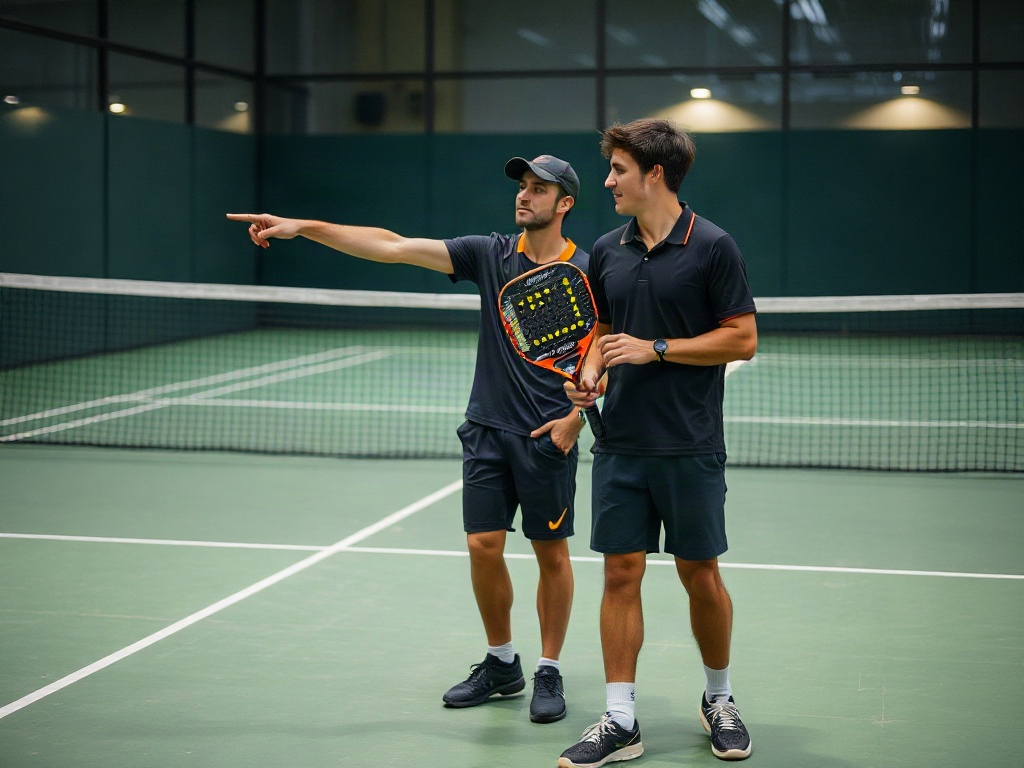

In padel doubles, the middle ball is where strategy, trust, and timing all collide. It is rarely just a simple shot; more often, it is the moment that reveals whether a partnership is organized or uncertain. When both players hesitate, a routine rally can turn into a mistake that hands away control. When both players attack without clarity, the same ball can become a collision of intentions instead of a clean, decisive play. That is why middle-ball decisions deserve more attention than most players give them. A strong doubles team does not merely react to the ball; it decides in advance how to share responsibility when the ball sits between them.
The best partnerships remove guesswork by building simple rules and reinforcing them through repeated communication. This does not mean every ball is handled the same way, because angle, bounce, court position, and handedness all change the decision. It means the pair agrees on a framework that makes split-second choices easier under pressure. The clearer that framework is, the less room there is for confusion, hesitation, and apology after the point. In practical terms, this is not only about technique, but about teamwork habits that hold up when rallies get fast. The middle ball becomes easier when both players know who is responsible, when to speak, and when to yield.
Understanding the Middle Ball in Padel

The middle ball is any shot that lands or travels in the zone between two doubles partners, creating a shared responsibility. On paper, that sounds simple, but in actual play it is one of the most complicated decisions in padel. The reason is that both players can often reach the ball, yet only one should usually take it. If neither moves early, the ball slips by untouched; if both move aggressively, the result can be awkward spacing or a rushed contact. This is why the middle area is so closely tied to team rhythm. It is not just a location on court, but a recurring test of decision-making.
Doubt appears because the middle ball sits in the overlap between two players’ zones, and overlap naturally invites hesitation. One player may think the other has the better angle, while the other assumes the same thing from the opposite side. Handedness can also complicate the choice, since a right-handed player on the left side may have a stronger forehand option than a partner in the opposite position. Court positioning changes the picture again, especially when one player is deeper or closer to the net. Strengths matter too, because some players feel more comfortable handling pressure balls while others prefer to avoid awkward reaches. In the end, the uncertainty is not about the ball itself, but about who feels entitled to it in that moment.
- Overlapping coverage makes the decision less obvious.
- Handedness can create a better forehand or backhand angle for one partner.
- Different levels of speed, balance, and confidence influence who should attack.
- Silence often turns a manageable ball into a missed opportunity.
- Repeated hesitation weakens trust over time.
Basic Communication Rules for Doubles Partners

Good communication starts before the point, not during the panic of the rally. Partners should agree on short, unmistakable verbal cues that leave no room for interpretation. A useful system does not need to be complicated; in fact, the simpler it is, the more likely it is to work under stress. Players should also decide whether they will prioritize aggression, safety, or position when the middle ball is contested. This kind of planning gives each player a mental map that reduces hesitation. Once the match begins, the key is consistency, because mixed messages are often worse than no message at all.
Calling the ball early is one of the most effective habits in padel doubles. A late shout can confuse your partner, while an early one creates space and confidence. Communication should also be direct enough that the other player knows whether to attack, defend, or leave the ball alone. Many experienced pairs use the same language across matches because repetition makes their communication automatic. Even body language works better when it is backed by a verbal system that both players understand. In other words, the pair should not improvise their code in the middle of a rally.
Short calls are usually best because there is very little time to explain anything in the middle of a point. Words like “mine,” “yours,” and “leave it” are popular because they are fast, simple, and hard to misunderstand. “Mine” should be used when a player clearly intends to take the shot, while “yours” helps signal that the partner has better access. “Leave it” is especially useful when a ball is heading toward the player who should not intervene. The real value comes from using the same words every time, so the call becomes instinctive rather than emotional. Once partners trust the language, they spend less energy deciding and more energy executing.
- Mine: Use when you are taking full responsibility for the ball.
- Yours: Use when your partner has the better angle or position.
- Leave it: Use when you want your partner to let the ball pass or when you want to handle it yourself.
- Help: Use sparingly when the situation is unclear and you need a quick response.
Who Should Take the Middle Ball?
There is no universal rule that applies to every rally, but there is a practical default that helps most pairs. The player with the stronger angle, better balance, or more natural forehand access often has priority. In many cases, that means the forehand side player is favored when the ball comes between both partners, especially if the contact can be made early. However, the best decision is not always the technically ideal one on paper. A player who is moving well, sees the ball early, and can hit with confidence may be the better choice even if the other partner is nominally closer. Communication and agreement matter more than rigid theory because the game rewards clarity, not guesswork.
| Situation | Likely Advantage | Why It Matters |
|---|---|---|
| Ball is between both players at medium pace | Player with better forehand access | Cleaner contact and stronger shot selection |
| Ball is fast and awkward | Player in best balance | Stability is more important than theoretical ownership |
| One player is deeper or off-balance | Player closer to ideal hitting position | Reduces hesitation and mishits |
| Left-right pairing creates a natural forehand | Forehand-side player | Often offers a more aggressive and controlled shot |
These patterns help, but they should never become rigid excuses for poor judgment. A right-side player may take a middle ball if the left-side partner is stretched, late, or poorly positioned. A left-handed player may change the pattern entirely because the angles flip in a useful way. The best teams adapt on instinct because they have already discussed the likely exceptions. When those exceptions happen, the pair does not freeze; it follows the agreed logic. That makes the middle ball less about hierarchy and more about readiness.
Not every middle ball should be handled according to a fixed default, because some situations are simply too dynamic for that. A fast ball with a bad bounce may demand that the more stable player step in, even if that is not the usual assignment. Defensive positions can also change the answer, especially when one player is recovering from a lob or moving backward. Left-handed and right-handed combinations often require custom coverage rules because the natural forehand lanes are different. If one partner is visibly better at volleying under pressure, the team may let that player claim more middle balls in tight exchanges. Flexibility is useful, but only when it sits on top of a clear baseline.
- Fast balls may override normal side-based responsibility.
- Awkward bounces often favor the player with better balance.
- Defensive recovery can shift the decision to the more ready partner.
- Left-handed and right-handed pairings may need custom patterns.
- Pressure moments often reward the calmer and more stable player.
Non-Verbal Communication on Court
Words are important, but padel moves too quickly to rely on speech alone. Non-verbal cues can confirm a decision before the ball even arrives, which helps both players stay aligned. A small step forward, a clear racket movement, or direct eye contact can signal intent without needing a shout. This matters most during fast exchanges near the net, where there may be no time to call every ball. When body language is consistent, your partner can read your decisions almost automatically. That kind of silent coordination is often what separates an organized pair from a reactive one.
The most useful non-verbal signals are usually the simplest ones. Players should avoid exaggerated gestures that create confusion or distract from the point. Instead, they can use purposeful movement to show who is taking space and who is giving way. Eye contact before a serve return or after a lob can also reduce uncertainty. Over time, this makes the partnership more efficient because the players begin to anticipate each other’s choices. In a close match, that efficiency can be as valuable as shot power.
Partner Coordination Before the Match
The smartest doubles teams discuss middle-ball responsibility before the first point is played. This conversation does not need to be long, but it should be specific enough to cover the most likely scenarios. Partners should talk about preferred sides, comfort under pressure, and any physical or technical differences that affect coverage. A player with a stronger backhand volley might want fewer middle balls on that side, while another may prefer to attack more aggressively. These details help both players understand how to support each other instead of competing for the same shot. Preparation before the match is one of the easiest ways to prevent confusion later.
- Agree on basic ownership rules before the first point.
- Discuss which partner handles contested balls more often.
- Review strengths such as forehand, backhand, and net coverage.
- Identify situations where the default rule can change.
- Confirm the verbal calls you will use during pressure points.
Mistakes to Avoid
The most obvious mistake is when both players go for the same ball and create a collision of movement or racket paths. That is often the result of poor communication, but it can also happen when partners have not agreed on a clear default rule. Silence is another common problem because a quiet team has to make every decision from scratch. Some players also change their decision mid-match without explaining the adjustment, which leaves the other partner guessing. Another mistake is overthinking, because hesitation often turns an ordinary middle ball into a lost point. The solution is not to think less, but to think earlier and communicate more clearly.
It also helps to avoid emotional blame after a mistake. Even good teams misread middle balls from time to time, especially under fatigue or pressure. What matters is whether the pair corrects the pattern and restores trust quickly. A short discussion between points is often enough to reset the plan. If the same error keeps happening, the team should revisit its communication rules instead of assuming one player is simply at fault. In doubles padel, shared responsibility should lead to shared improvement.
Drills to Improve Middle-Ball Decisions
Practice is the fastest way to make middle-ball decisions feel natural. One useful drill is to rally deliberately toward the center and require both players to call each ball before contact. This trains speed of decision and reduces hesitation during actual matches. Another drill is to switch roles repeatedly so each partner learns the other player’s tendencies. The more often the team repeats these patterns, the less they need to negotiate in real time. Good drills do not just improve technique; they build a common language.
It also helps to add pressure gradually so the communication holds up when the pace increases. Start with controlled feed drills, then move to live rally situations where middle balls appear unpredictably. Partners can review which calls were clear and which were delayed after each set of repetitions. That feedback loop matters because communication becomes stronger when players can identify small breakdowns early. Over time, the pair develops habits that hold up in matches, not just in warm-up. The result is a more confident partnership that responds rather than reacts.
Итог
Who takes the middle ball in padel is never just a technical question; it is a communication question first. The most effective doubles partners create simple rules, speak early, and adjust intelligently when the rally demands it. Clear ownership prevents hesitation, while flexible awareness prevents rigidity. When both players understand the logic behind the decision, the middle ball becomes an opportunity rather than a problem. That shift in mindset can improve timing, trust, and shot quality all at once. In the end, strong communication turns shared uncertainty into shared control.
Часто задаваемые вопросы
- Who usually takes the middle ball in padel?
Usually, the player with the better angle, stronger forehand position, or more stable balance should take it. However, the best answer depends on the pair’s agreed communication rules and the exact situation on court. - What should I say if I want the ball?
Short calls such as “mine,” “yours,” and “leave it” work best because they are fast and easy to understand. The important thing is to use the same words consistently so your partner reacts instantly. - Does the right-side player always take middle balls?
No, not always. Side position matters, but handedness, balance, and the quality of the angle can change who should play the shot. - How can we avoid confusion during rallies?
Agree on a basic rule before the match, use clear verbal calls, and support them with body language. The more consistent your system is, the less often you will hesitate. - What if both players go for the same ball?
Do not let one mistake create a bigger problem. Reset quickly, talk between points, and clarify which player should take that type of ball next time.