
In padel doubles, positioning is not just about standing in the right place; it is about controlling time, space, and options before the ball is even hit. The pair that moves with clarity usually makes the court feel smaller for the opponents and easier for themselves. A strong position can turn a routine rally into pressure, while a poor one can invite lobs, gaps, and easy finishes. The best teams do not simply chase the ball, because they understand how their shape affects every shot in the rally. If you want to attack with confidence and defend with purpose, your positioning has to become part of your decision-making, not an afterthought. This is where smart doubles movement starts to separate steady players from effective ones.
What makes padel especially tactical is that every position has a purpose, and that purpose changes depending on whether you are under pressure or in control. When your team is attacking, your job is to stay connected to the net and deny easy passing lanes. When you are defending, the goal becomes survival first, then recovery, then rebuilding your chance to move forward. Many players think of padel as a shot-making game, but the reality is that court spacing often decides which shots are available. Understanding where to stand helps you support your partner, protect the middle, and react earlier to lobs, volleys, and smashes. Once that becomes natural, your entire game starts to feel more compact and much more organized.
The Basics of Padel Doubles Court Positioning
Before you can position yourself well in attack or defense, you need to understand that padel is played as a connected pair rather than two separate players. Good doubles teams move almost like a single unit, with both players reacting to the same ball and the same court geometry. If one player steps forward while the partner stays back without a reason, the court opens up immediately. The same applies when one player drifts too wide and exposes the center, because the opponents will usually notice and exploit it. The key idea is that you are not simply covering your own half; you are protecting the spaces between you and your partner. That shared responsibility is what turns basic movement into real doubles structure.
The court can be broken into zones that help simplify decision-making during a rally. The back area is usually where defensive work begins, especially after deep returns or heavy pressure from the net team. The transition area is where many points are lost or won, because players are moving forward or backward and are most vulnerable to well-placed shots. The net area is the strongest offensive zone, since it shortens the opponent’s reaction time and creates angles for volleys and finishing shots. Once you start reading the court in zones rather than just lines, your choices become faster and more deliberate. That shift in perspective is one of the easiest ways to improve tactical awareness.
Each zone demands a slightly different mindset, and the best players adjust their spacing according to what the rally is asking for. When you are near the baseline, your priority is to absorb pace, recover efficiently, and keep the ball deep enough to delay the opponent’s approach. In the transition zone, balance matters more than aggression, because you may need to split-step, change direction, or handle a difficult bounce at short notice. At the net, your stance becomes more proactive, with your body prepared to block, volley, and control the middle. The side glass and back glass also influence your position because they create extra ball paths that must be anticipated rather than reacted to late. Learning these zones is a practical way to reduce hesitation and move with more confidence.
Where to Stand When Attacking

When your team is attacking, the strongest place to be is usually as close to the net as you can hold without losing balance. That does not mean standing recklessly forward or chasing every ball inside the service line, because overcommitting can make you easy to lob. Instead, the ideal attacking position is one that allows you to intercept weak replies while still being ready to retreat if the ball is lifted over you. Your stance should feel active, springy, and connected to the middle of the court. This is where the pair can create real pressure, because the opponent has less time and fewer safe angles. A good attacking position is less about standing very high and more about standing in a way that keeps the point on your terms.
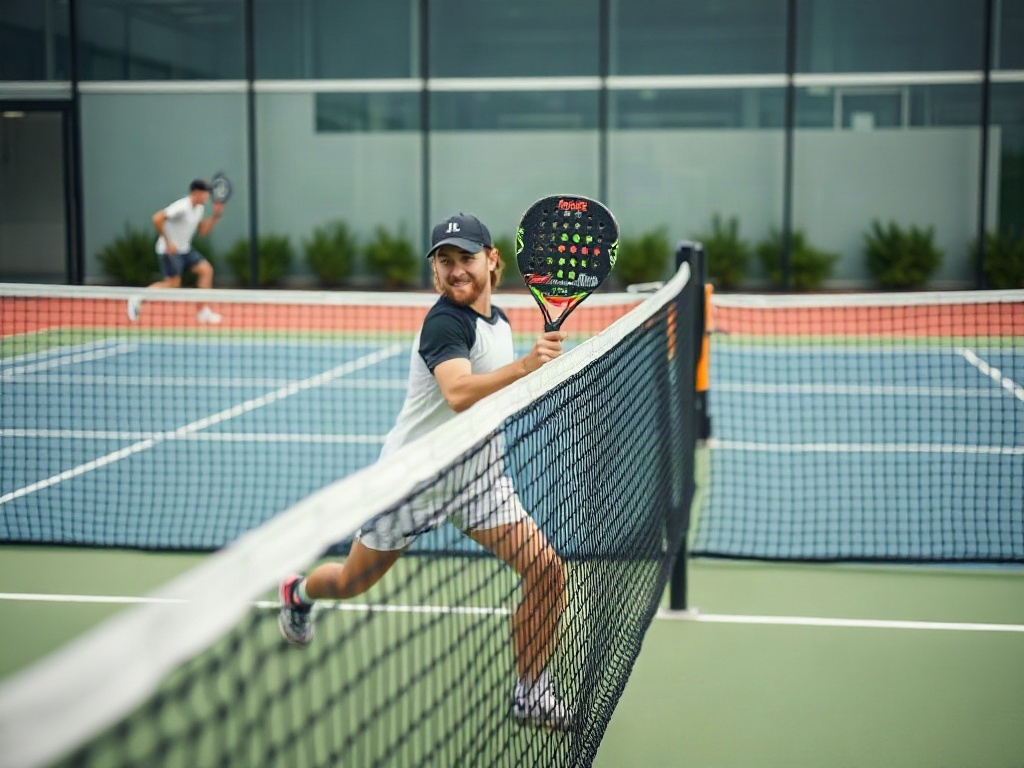
At the net, both players should remain compact enough to protect the center while still covering their own side of the court. The player on the side of the incoming ball often gets the first chance to volley or pressure the return, but the partner must stay close enough to respond to the next ball. If the two of you drift apart, the opponents will look for the gap between you, especially with sharp cross-court angles or passing attempts. A narrow and coordinated net shape makes it harder for them to find clean winners. Communication also matters here, because one player may be ready to close, while the other may need to hold a slightly deeper line. The best attacking teams look calm, but their positioning is always active and intentional.
- Stay just behind the net line when possible, rather than standing too deep and surrendering pressure.
- Protect the middle first, because most dangerous passing options travel through that space.
- Keep your knees flexed and your weight forward so you can react to blocks and quick volleys.
- Adjust your depth together with your partner so the net shape remains tight and balanced.
- Be ready to retreat a step if the opponent produces a lob, instead of standing frozen in place.
Once you win the net after a lob, your positioning must reward that success without becoming exposed to the next counterattack. If you hit a smash or bandeja, the recovery step is just as important as the shot itself, because your stance after contact determines whether you can keep the advantage. Many players make the mistake of admiring a good overhead instead of immediately resetting into an active net position. After the shot, both players should recover in sync, re-establishing pressure while protecting the center. If the ball stays in play, the team that recovers first usually controls the next exchange. This is why post-overhead positioning is a fundamental part of attacking, not just a cleanup detail.
| Situation | Recommended Position | Primary Goal |
|---|---|---|
| Attacking from the net | Just behind the net line, compact with your partner | Apply pressure and cut off passing lanes |
| After a lob is defended | Recover to a balanced net stance | Regain control and prepare for the next ball |
| Defending from the baseline | Deep, balanced, and ready to use the glass | Absorb pressure and buy time |
| Transitioning forward | Controlled steps through the middle zone | Move from defense to net control safely |
The table above shows that positioning changes with the purpose of the rally, not just the location of the ball. A team that understands these adjustments can move from one phase to another with much less friction. The depth of your position after an overhead should depend on the quality of the shot and the likely reply from the opponents. If your smash is defensive rather than finishing, you may need to hold a little higher than baseline depth but not overextend into risky space. If your bandeja is controlling, then your recovery can be aggressive, because the goal is to continue the net lock. These subtle differences matter because they shape the rhythm of the point.
Where to Stand When Defending
Defending in padel doubles starts with discipline, patience, and a clear understanding that your first job is to survive the pressure without losing shape. Most defensive positions begin near the baseline, where both players can use the glass and see the opponent’s net positioning clearly. Standing too far forward while under attack often makes you vulnerable to low volleys and awkward balls at your feet. Standing too deep, however, can give the opponents too much room to angle the ball or use shorter placements. The right defensive position is usually one that lets you read the shot early, move with balance, and return the ball deep enough to delay the attack. Good defense is not passive; it is structured and responsive.
From the baseline, you and your partner should remain aligned enough to protect the middle but not so close that you interfere with each other. The ball should be played with the intention of resetting the point, ideally forcing the net team to hit another shot rather than finishing immediately. Using the back glass effectively is one of the biggest defensive strengths in padel, because it gives you extra time to prepare your stroke. The best defenders do not rush to the ball; they let the ball come into their hitting zone and then return it with control. If your opponents are crowding the net, your defensive spacing should prioritize depth and safety over risk. That patience creates the opening you need to move forward later.
- Hold a balanced stance near the baseline when the opponents control the net.
- Use the glass to buy extra time and improve shot preparation.
- Keep your returns deep and central when possible to reduce the opponent’s angles.
- Stay coordinated with your partner so the middle does not become a free target.
- Look for opportunities to transition forward only after a strong defensive reply.
When the opponents attack aggressively, your defensive positioning has to become even more disciplined. Against strong volleys or smashes, the goal is to reduce their direct scoring chances and force them into one more shot. That often means staying compact, reading the bounce early, and defending with controlled footwork rather than big, rushed movements. If the ball comes high off the glass, your recovery should still favor balance over panic, because a wild swing usually creates more problems than it solves. You also want to protect the center of the court, since aggressive net players often try to close down the middle with pace. Smart defensive positioning makes their attack feel less dangerous and gives you more time to reset the rally.
As the rally develops, the transition from defense to attack becomes possible when you notice a shorter ball, a weaker overhead, or a return that lands less threateningly than expected. That moment is where many pairs fail to move together, with one player advancing while the other remains stuck. If you want to turn defense into offense, your movement has to be coordinated and gradual rather than sudden and chaotic. A good rule is to move forward only when your shot has forced the opponent into a defensive reply. Once that happens, your spacing can compress and your net ambitions can return. This is how a team rebuilds control without gifting space behind them.
Common Positioning Mistakes in Padel Doubles
One of the most common errors in padel doubles is standing too far apart from your partner, especially when the point becomes fast or uncomfortable. That separation makes the middle of the court vulnerable and forces both players into awkward decisions. Another frequent mistake is moving too early, which can open space behind you or invite a simple counterattack into the gap you just left. Some players also overattack from poor court position, trying to finish a point while still in a defensive or transitional zone. The result is usually a low-percentage shot and a return to pressure. Good positioning prevents many of these issues before they appear.
There is also a mental side to positioning mistakes, because many players react to the ball instead of reading the whole point. When you focus only on the shot in front of you, it becomes easy to forget where your partner is standing or what space has been left uncovered. Over time, this creates a pattern of reactive movement that works against doubles structure. The best correction is to slow your decisions slightly and reconnect with the shape of the court on every rally. Even a small adjustment in depth or width can make the point feel more stable. Positioning improves fastest when players treat it as a shared habit rather than a personal preference.
- Avoid drifting too wide, because the center becomes easier to attack.
- Do not chase every ball forward if your partner is still recovering.
- Resist the urge to finish points from unstable positions.
- Keep checking your spacing after each shot, not only before the point starts.
- Move with purpose so your partner always understands your next step.
Tactical Adjustments Based on Ball Situation
Padel positioning is never identical from one rally to the next, because the ball itself changes the geometry of the court. A lob forces both teams to reassess depth, timing, and recovery lines, while a low cross-court shot can pull one player out of shape if the partner does not adjust. Down-the-line balls often test spacing because they can create sudden pressure on the player covering that lane. The better you read the ball situation, the less likely you are to stand in a place that no longer makes sense. This is why advanced doubles play depends on constant micro-adjustments rather than fixed positions. Every shot should trigger a small repositioning decision, even if the movement is only a step or two.
These tactical changes are easiest to manage when both players know their priorities in each phase. Against a lob, the team should think about who is taking it, who is covering behind, and where the next contact point will likely happen. Against a low drive, the priority may be to block, recover, or maintain the line rather than overreach for a risky volley. If the ball is pushed wide, the partner must narrow the court shape quickly to keep the central lane protected. This is the essence of doubles teamwork: the ball moves, and the pair responds together. When that response is automatic, positioning stops feeling like a problem and starts feeling like an advantage.
Communication and Team Movement
Positioning becomes much stronger when communication is simple and consistent. A clear call on a ball can prevent hesitation, especially on shots that land between both players or require a quick decision at the net. Your body language also matters, because a confident step forward or a deliberate hold can tell your partner exactly what you intend to do. Teams that move well together usually do not overexplain every ball, but they do establish enough clarity to avoid confusion. In doubles, silence can work if the habits are strong, but uncertainty rarely helps. The most efficient pairs make movement feel obvious to each other.
Movement as a unit is just as important as verbal communication, because positioning is visible before it is spoken about. If one player moves forward after a short ball, the partner should often follow the same rhythm to preserve the court shape. If one player is pulled back by a lob, the partner may need to deepen slightly as well so the team stays balanced. This shared movement protects against open gaps and makes it harder for opponents to identify weak spots. Over time, teams that move together begin to anticipate each other’s habits. That anticipation turns positioning into an instinct rather than a checklist.
- Use short, clear calls such as “mine,” “yours,” or “switch” when needed.
- Match your partner’s forward or backward movement to keep the shape of the court intact.
- Agree on who takes lobs, middle balls, and fast returns before pressure situations appear.
- Keep your signals simple so communication does not slow down the rally.
- Watch your partner’s feet and shoulders, because movement often starts there before the shot is played.
Drills to Improve Padel Doubles Positioning
Improving positioning does not require complicated routines, but it does require repetition with intent. Net control drills help you learn how close to stand, how to cover the middle, and how to recover after each volley. Defensive recovery drills teach you to move from the baseline into a safer shape after handling pressure. Partner movement drills are especially useful because they train both players to shift together rather than independently. Transition play practice helps you recognize when to move forward and when to hold your ground. The more often these patterns are repeated, the faster they become natural in match play.
It is also useful to practice with constraints, because constraints force decision-making under pressure. For example, you can set a drill where only deep returns count, or one where the pair must recover to the net after every lob. These exercises make positioning visible, measurable, and easier to correct. They also expose habits that do not show up in casual games, such as drifting too wide or recovering too slowly after an overhead. If you record your drills or get feedback from a coach or partner, the learning becomes even faster. Good positioning is teachable, but it improves most when players notice the exact moment their shape breaks down.
Итог
Padel doubles positioning is ultimately about helping your team stay connected to the point, not just to the ball. When attacking, you want to build pressure from a strong net shape that blocks the middle and keeps your opponents uncomfortable. When defending, you want to stay balanced, use the glass, and buy enough time to reset the rally. The best players are not always the ones hitting the most spectacular shots; they are often the ones standing in the smartest place before the shot even arrives. That is why positioning deserves the same attention as technique and tactics. If you improve where you stand, you improve how every other part of your game functions.
As you practice, focus on movement as a pair, because doubles success depends on shared responsibility. Stay compact when attacking, disciplined when defending, and flexible when the ball changes the shape of the rally. Avoid the common mistakes of drifting apart, overcommitting, or reacting too late to the next shot. The more you train these habits, the more natural they become in real matches. In the end, smart positioning does more than prevent mistakes; it creates the conditions for better shot-making and stronger teamwork. That is what makes it one of the most valuable skills in padel doubles.
Часто задаваемые вопросы
- Where should I stand when my team is attacking in padel doubles?
You should usually stand close to the net, stay compact with your partner, and protect the middle while being ready to react to lobs or quick counterattacks. - Where should I stand when defending in padel doubles?
You should stay near the baseline with your partner, use the glass when needed, and focus on returning the ball deep enough to slow the opponents down. - Should both players move together in padel doubles?
Yes, moving together helps preserve court shape, protects open space, and makes it harder for opponents to exploit gaps between you. - What is the biggest mistake in padel doubles positioning?
One of the biggest mistakes is leaving the middle open or standing too far apart, which creates easy angles and attacking opportunities for the other team. - How do I know when to switch from defense to attack?
Look for a weak lob, a short ball, or a defensive reply from your opponent, then move forward together only when your shot has created enough safety to do so.